The monasteries above the town
A short drive up behind Skopelos Town brings you to Evangelistria, Prodromos and Metamorfosis, looking straight back down over the harbour. Go early, cover your shoulders, and walk the last stretch if you can.
The island
Skopelos is the green one. While most Aegean islands are rock and scrub, this one is covered in Aleppo pine right down to the waterline, so the beaches are backed by shade and the sea is an inviting deep green-blue. It is also protected: most of the island is forest, there is very little building outside the two towns, and nothing happens in a hurry.
Beaches
The south and west coasts have the sheltered water. These are the ones worth the drive, in rough order of how far you go.
Which one
Stafylos and Velanio are the closest and the easiest with children — sand, shallow water, and a taverna at the top of the steps.
Milia is the long one: pebbles, pine to the edge of the beach, and Dasia island sitting out in front of it. Limnonari is a small sandy bay with somewhere to eat at the back. Kastani is the one people know from the film, and it is genuinely beautiful, though it fills up in August.
Glysteri, just north of the town, is close enough to reach for an afternoon and pretty enough to stay all day. When the meltemi blows from the north, go south.
Days out
A short drive up behind Skopelos Town brings you to Evangelistria, Prodromos and Metamorfosis, looking straight back down over the harbour. Go early, cover your shoulders, and walk the last stretch if you can.
The chapel on the rock at the north-east corner, reached by a hundred-odd steps cut into the stone. It became famous as the church in Mamma Mia! The view from the top is the reason to go.
Alonissos sits inside Europe’s largest marine protected area, home to the Mediterranean monk seal. Day boats run from Skopelos Town in season, usually stopping to swim on the way.
The island’s second town, high above Loutraki port, quieter and older-feeling than the Chora. Worth a long lunch and the drive along the coast road to get there.
Eating
Two things are genuinely local. The first is the Skopelos cheese pie: a coil of thin pastry around soft white cheese, fried and cut into wedges, eaten at any hour. The second is plums, which the island has dried and preserved for generations — you will find them in spoon sweets, in pork stews, and sold in every other shop in town.
Otherwise, eat fish on the harbour front, order the vegetables as seriously as the meat, and take the taverna at the back of a beach over the one at the front.
The town
Skopelos Town is not a resort. It is the island’s capital, built in an arc around the harbour and stacked up the hillside in white houses under terracotta and old stone roofs, laced with stepped lanes too narrow for cars. The count of churches and chapels within it is famously somewhere around a hundred and twenty-three.
Walk up through it in the evening to the ruins of the Venetian kastro, then come back down for dinner. It takes about twenty minutes and you will get lost, which is the point.
When to come
If you can choose, choose September: the sea is at its warmest, the crowds have gone home, and the tavernas are still open. Whenever you come, the day tends to end the same way — up on the terrace, watching the light go off the harbour.
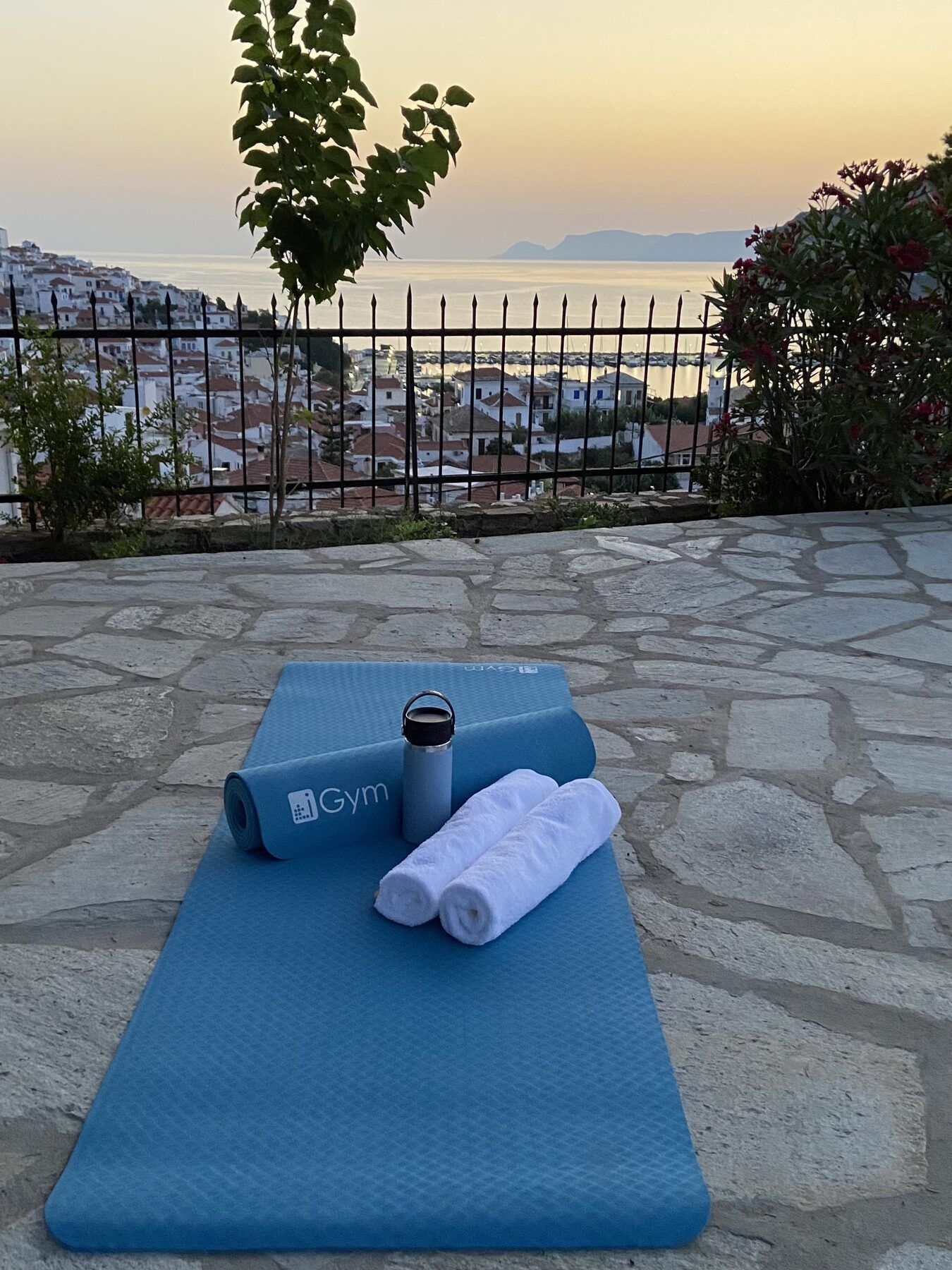
Villa Icelle sleeps seven, ten minutes above the harbour, with the pool waiting.